Squarespace Added Support for llms.txt—Here’s Why It’s Not the Magic Key to AI SEO in 2026
If your business runs on a Squarespace website, you might have seen the recent update allowing site owners to generate an llms.txt file.
The buzz in the website-building community was immediate. Promises of “ranking #1 in ChatGPT,” “getting cited by Claude,” and “future-proofing your AI SEO” started flooding social media feeds.
It’s easy to see why people are excited. Who wouldn’t want a simple text file that magically translates their website into language AI bots love to cite?
As a long-time Squarespace SEO strategist, however, I worry that people are falling victim to hype and a SaaS company’s attempts to look relevant in the Post-Keyword SEO Era.
Here’s the Squarespace AIO reality check: Creating an llms.txt file is not the magic key to Squarespace SEO or AI Optimization (AIO).
It won't instantly boost your rankings, it won't force Google AI Overviews to cite your brand, and—most importantly—no major search engine or foundational LLM crawler relies on it for content discovery or ranking.
You read that right: LLMs.txt is not a standard that’s been adopted by any major crawlers in 2026.
Let’s unpack what llms.txt actually is, why major AI companies aren't using it the way people think, and what you should actually do to rank in an AI-driven web.
What Is llms.txt (and What Is It Supposed to Do?)
Proposed in late 2024 by Jeremy Howard, llms.txt is an experimental, community-led proposal (note that word, proposal) for a Markdown file placed in a website's root directory (the file location would look something like: example.com/llms.txt).
Think of it like a simplified sitemap or curated reading list designed specifically for large language models. Here’s how llms.txt would theoretically fit into your backend up website ecosystem:
robots.txt tells web crawlers where they are allowed to go.
sitemap.xmllists every URL on your site for search engines.
llms.txt gives a distilled, text-only overview of your site's most critical pages in Markdown file format.
The intent was noble: clean up web clutter so AI crawlers and agents don't have to digest heavy HTML, JavaScript, or ads.
The Big Catch: No Major LLM Crawler Uses llms.txt for Discovery or Ranking
Here is the single most important detail that the AIO hype cycle ignores: llms.txt is an unofficial proposal, not an adopted web standard.
Make it stand out
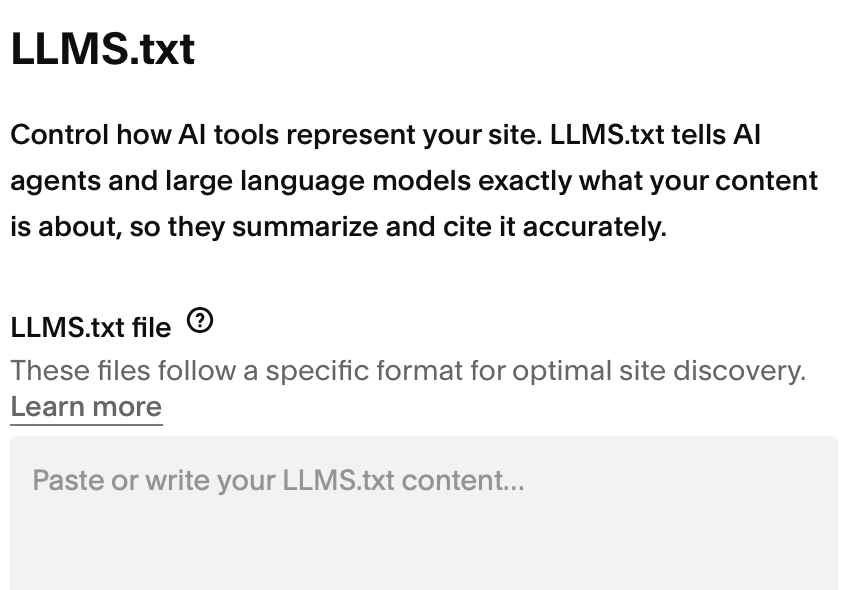
A screenshot of Squarepace’s LLMs.txt panel. It makes the bold and inaccurate claim that input into this panel will tell LLM software how to cite your website. This is misleading.
Google: Google Search and Google AI Overviews do not use llms.txt for crawling, indexing, or ranking. Nor does it use this file type when determining if they will cite your website in an AI overview. In fact, Google’s search team has repeatedly and explicitly stated that publishers do not need to create Markdown files or specialized AI files to appear in generative search.
OpenAI (aka ChatGPT): OpenAI's core web crawlers rely on standard web protocols (HTML, XML sitemaps, standard web indexes) that already exist on your website, not llms.txt files.
Anthropic (aka Claude): While Anthropic publishes an llms.txt file on their own developer documentation site, their web crawlers do not require or prioritize third-party sites because they have an llms.txt file.
As highlighted in analysis by Ahrefs, Semrush, and SE Ranking (which analyzed over 300,000 domains), there is zero statistical correlation between having an llms.txt file and getting cited more frequently by AI models.
What Google Says About llms.txt
When asked about llms.txt and its role in AI search discovery, Google’s Senior Search Analyst John Mueller gave a straightforward breakdown on Google’s podcast of why self-reported text files fail as ranking signals:
“It's basically you're telling these systems: 'I have the best website ever. And here are all of the pages that everyone must go to...' So an LLM system, basically by design, can't trust what is here as a way of differentiating between different websites.” — John Mueller, Google Search Relations
Mueller points out a fundamental truth about search and AI retrieval: self-reported claims carry zero weight.
If every website submits an llms.txt file claiming to be the definitive expert on a topic, an AI system still needs independent, verifiable signals to evaluate authority. I could claim in my llms.txt file that my website is the definitive source for caring for your yak, but unless I prove my yak caretaking expertise in a multitude of ways, why would any crawler believe me? That’s not how the internet works.
That’s why AI search models prioritize:
Real user engagement and backlink signals.
Established content structures (that also support traditional SEO).
High-quality, original content written by real experts (E-E-A-T).
Where llms.txt Does Matter (And Why Squarespace Added It)
If it doesn't help your SEO, why did Squarespace bother building support for llms.txt?
It serves niche, agentic workflows: If an AI agent is already visiting your exact URL to perform a task (e.g., retrieving an API spec or summary), an llms.txt file provides a lightweight map once the agent is already on-site. This is still a niche use, but it may be important to some Squarespace website users.
It's a low-hanging feature for CMS platforms: Adding automated support for a Markdown file is technically easy for Squarespace, allowing them to market “AI-ready features” to users. Basically, it’s an easy way for them to look proactive without actually investing in their CMS’s infrastructure.
Having an llms.txt file on your Squarespace site won't likely hurt you. But relying on it as a marketing strategy is like putting a shiny new bumper sticker on a car with no engine and expecting it to win a race.
What Actually Works for Squarespace SEO & AIO
If you want your Squarespace site to rank in Google Search and get cited by software such as ChatGPT, Gemini, and Perplexity, focus on fundamentals that AI models actually extract:
Build Strong E-E-A-T Signals: Show clear author bios, original research, customer testimonials, and authoritative brand mentions.
Use Clean Headings and Visible Q&A Formatting: AI models pull snippets from well-structured content. Write clear, direct answers right below logical H2 and H3 subheadings. Squarespace users tend to hide their Q&As due to slapdash template development on Squarespace’s part, so check yours!
Control AI Bots via robots.txt: If you want AI engines like OpenAI or Perplexity to crawl your site, ensure your robots.txt settings aren't inadvertently blocking GPTBot, PerplexityBot, or ClaudeBot. There’s a toggle in Squarespace to allow you to control bots’ access to your site. If you want AI crawlers to see your site, make sure you’re not blocking them.
Earn Off-Site Authority: AI engines learn about your brand by analyzing what other trusted websites, news outlets, and forums say about you. Also, ensure your social media, Google Business Profile, and other online properties are consistent in terms of your messaging and factual data
The Bottom Line About Squarespace & LLMs.txt
Squarespace adding llms.txt support is a nice-to-have technical convenience, IF (and that’s a big if) it gets adopted, but it is not a ranking shortcut.
Don't let shiny new acronyms distract you from what has always driven search visibility and is driving AI citations too: clear content, technical health, real authority, and solving problems for human readers first.
Need a Quick SEO Gut Check?
Forget the llms.txt hype. Let's spend 90 minutes auditing your actual site structure, clearing Search Console errors, and optimizing your Squarespace site for real human searchers and AI crawlers alike.
👉 Key Takeaways: Squarespace and LLMs.txt
1. llms.txt Is an Unofficial Proposal, Not an Established Web Standard
Created in late 2024, llms.txt was designed as a Markdown-formatted, text-only overview to give AI models a clean reading list of a site's key pages. However, it remains a community proposal and has not been adopted by major search engines or LLM crawlers as an official protocol for crawling or indexing.
2. Major AI Engines and Search Crawlers Completely Ignore It
Having an llms.txt file does not correlate with higher search rankings or increased citations in AI tools:
Google: Google Search and Google AI Overviews do not rely on llms.txt for indexing or citation decisions. Company representatives have confirmed that self-reported text files carry no weight for establishing domain authority or ranking priority.
OpenAI & Anthropic: Core AI web crawlers (like GPTBot and ClaudeBot) index the web using standard web protocols (HTML structure, XML sitemaps, traditional indexes) rather than relying on llms.txt.
3. Why Squarespace Added It Anyway
Squarespace introduced built-in support for llms.txt because it is low-hanging technical fruit that allows them to market "AI-ready" features to users. While it can serve niche, agentic workflows (where an AI agent is already on a specific URL performing a task and needs a lightweight site map), it functions as a convenience feature rather than an SEO strategy.